
Practical, confidential mediation that helps separating families make clear decisions without the stress, expense and uncertainty of court.

Family separation touches every part of daily life. Mediation provides a calm, neutral environment where both parties can work through priorities and reach agreements that genuinely reflect their circumstances.
When couples separate and families are in conflict, emotions run high. In this charged atmosphere, communication becomes difficult and effective decision-making feels almost impossible. Mediation offers a structured alternative a confidential setting where these conversations can take place with the guidance of an impartial professional who helps everyone communicate more clearly, understand one another's concerns, and work toward practical arrangements that allow life to continue.
Mediation is entered into freely. Sessions are private, and what is discussed within them cannot ordinarily be used in court proceedings. This confidentiality encourages honest, open dialogue that may not be possible in a more adversarial setting.
Rather than assigning blame or adjudicating disputes, the mediation process focuses on practical outcomes. Parenting arrangements, household finances, school routines and long-term communication plans are all addressed in a structured, stage-by-stage process.
Children's needs and wellbeing sit at the heart of everything. Mediators help parents translate genuine concern for their children into concrete plans that protect routines, maintain stability and reduce the friction points that often cause difficulties later.
Courts operate within legal frameworks that do not always accommodate the specific routines and needs of individual households. Mediation allows families to design arrangements that fit their real lives.
School timetables, childcare responsibilities, and children's existing habits are all taken into account producing arrangements that are genuinely workable day-to-day.
Sessions are held in a confidential setting, free from the formal process and public exposure of court proceedings. Families can speak honestly and explore all available options.
By directing all discussions toward cooperation and problem-solving, mediation reduces ongoing conflict and fosters a more respectful long-term dialogue between parents.
Agreements that both parties have helped shape are agreements both parties are far more likely to maintain. Ownership of the outcome makes long-term compliance more natural.
Rather than waiting for lengthy court processes, families can begin addressing their concerns directly, often resolving matters far more quickly and with considerably less emotional strain.
The focus on children's routines, schooling, relationships and emotional wellbeing runs throughout every stage of the process, keeping what matters most firmly in view.

A clear, structured process guides families from first contact through to a written agreement with confidentiality and informed consent emphasised at every stage.
A brief, confidential conversation to explain the process, answer initial questions and arrange a Mediation Information and Assessment Meeting if mediation appears appropriate and safe for both parties.
An individual, private discussion that explains the mediation process in full, outlines how confidentiality works, and assesses whether there are any safeguarding or legal reasons mediation should not proceed. This is an information and assessment conversation, not a negotiation, and it helps both parties decide whether to move forward.
Each participant receives a short outline of the process together with a checklist of documents that may be helpful — for financial discussions, summaries of assets and liabilities; for parenting matters, school and care timetables. Practical preparation makes sessions more productive.
Mediated conversations led by an impartial mediator who ensures fairness and safety throughout. Sessions work through one topic at a time and build a written record of agreed points. Sessions vary in length; for most families, a series of focused meetings is more productive than one extended conversation.
When both parties are ready, the mediator helps draft a written agreement that clearly reflects every decision reached. This record sets out the practical steps both parties will take and can subsequently be formalised with legal advisers if required.
Brief follow-up guidance on how to formalise the agreement through solicitors if either party chooses, and on further support should new issues arise. Mediation can be paused or revisited if circumstances change.
Mediation is most effective when both parties are willing to engage constructively and are ready to prioritise their children's stability and their own long-term wellbeing.
It is particularly well suited to separating couples who want to make practical decisions about parenting, finances or property without the adversarial dynamic of court proceedings. Extended family members, including grandparents, may also benefit where disputes over contact or support roles have arisen.
Mediation may not proceed where there are unresolved safety concerns, including situations involving domestic abuse, coercion, or immediate risk of harm. In such cases, the mediator will discuss alternative routes, signpost specialist support services, and explore whether any safer approach is possible.
Safety is always the primary consideration. A MIAM assessment is designed precisely to identify these situations early and ensure nobody is placed in an unsafe environment.

A comprehensive range of mediation services to meet the varied needs of separating families and those navigating complex family dynamics.
An initial confidential meeting that explains mediation fully, assesses suitability and safety, and helps both parties decide whether to proceed. A MIAM is also required in certain circumstances before applying to court for family orders.
A neutral space to address the many practical decisions that separation brings — clarifying priorities, exploring options in stages, and drafting clear written agreements covering both parenting and financial matters.
Child-focused practice that helps parents design parenting arrangements protecting children's routines, schooling and emotional wellbeing. Clear plans covering residence, contact, holidays, school runs and day-to-day communication.
Structured discussions covering the division of household budgets, liabilities, property and savings. Mediators help both parties exchange information, clarify priorities and explore options, enabling formal agreements to be prepared with solicitors.
Support for parents thinking beyond immediate arrangements — addressing changes in schooling, new partners, or shifts in children's needs as they grow, and creating durable frameworks for communication and decision-making.
An independent space for grandparents and extended family members to discuss contact, support roles or childcare disagreements — respectful of everybody's position, with children's welfare at the centre.
Practical support for stepparents and blended households navigating roles, boundaries and shared responsibilities across households — making family life more predictable and cooperative for everyone involved.
Focused sessions for co-parents who want to improve how they communicate about practical matters — rebuilding communication patterns, reducing escalation and creating clearer, more constructive ways to manage disagreements.

Mediation is a practical, outcome-focused process. Understanding what to expect helps families engage productively from the very first session.
Sessions typically begin with a brief check-in to establish safety and immediate priorities. The mediator outlines the agenda and the ground rules — mutual respect, equal listening time and confidentiality. Emotional work is entirely normal; mediators are trained to manage difficult moments and can pause discussions if needed.
Every family is different. Some matters resolve in a small number of sessions; others take longer. The goal is practical progress, not adherence to a fixed timeline. A series of focused meetings is usually more productive than one extended conversation.

Safety is the primary consideration at every stage. Mediators follow strict professional codes of conduct and are trained to identify and respond to safeguarding concerns promptly.
Every mediator has completed recognised training in family mediation and child-focused practice, and maintains ongoing professional development to ensure safeguarding knowledge and skills remain current. Many hold formal accreditation and abide by established professional codes of conduct governing confidentiality, impartiality and professional boundaries.
If any situation raises child protection concerns, mediators follow strict procedures to ensure safety — which may include pausing the mediation and involving appropriate safeguarding agencies. Indicators of risk are addressed promptly and sensitively, and mediation will not proceed where unresolved safety concerns exist.
Where there is a history of domestic abuse, coercion or control, mediation may not be appropriate. Alternative routes, specialist support, and any safer approaches are discussed openly. The MIAM assessment is specifically designed to identify these situations and ensure no one is placed in an unsafe environment.
Reaching an agreement is an important milestone — but family circumstances change, and ongoing clarity and support remain important.
Once an agreement has been drafted, brief follow-up guidance is provided on how to formalise it through solicitors or the court if either party chooses. A mediated agreement is not automatically legally binding; it can be turned into a consent order or other formal document with the assistance of solicitors, and mediators can explain the available options clearly.
For families with longer-term co-parenting needs, further sessions can be arranged to address new issues as they arise — changes in schooling, new relationships, evolving children's needs, or shifts in financial circumstances. Mediation can be revisited at any stage.
The most durable agreements are those built around the realities of daily life. By focusing on practical arrangements — clear handover routines, agreed communication channels, contingency steps for holidays and school events — mediation reduces the stress of post-separation life and helps parents maintain cooperative relationships wherever possible.
Where complex financial matters require specialist input — such as pension valuations, benefits assessments or detailed legal interpretation — mediators will explain why specialist advice would be helpful and signpost solicitors, financial advisers or other practitioners who can provide that expertise alongside the mediation process.
Mediation is not a substitute for legal advice. Speaking with a solicitor alongside or following mediation is often appropriate — for example, to understand how a mediated decision can be turned into a legally binding consent order. Mediators are happy to explain these options but do not provide legal representation.
The most frequently asked questions about family mediation answered in plain, straightforward language.
Anonymised reflections from families who have been through the mediation process.
Clear, calm and practical — we left with a plan we could live with.
The process helped us focus on our child's routine when everything else felt chaotic. Having that clarity made an enormous difference.
The mediator kept every conversation constructive and down to earth. We made progress we would not have managed on our own.
Practical steps and sensible follow-up — we could move forward with confidence. I would recommend the process to anyone in a similar situation.

Experienced, accredited mediators who bring a calm, professional presence to what can be a highly stressful time focused entirely on practical, durable outcomes.
Mediators are trained to help parents and carers focus on practical arrangements — daily routines, schooling, contact plans while paying careful attention to safeguarding throughout. Impartiality is central: mediators do not take sides, recommend outcomes or advocate for either party. Instead, they design a fair process in which everyone is heard and encouraged to explore realistic options.
Sessions are conducted in a respectful, non-adversarial style. Mediators are mindful of diversity and inclusion and adapt their approach to accommodate different cultural, linguistic or accessibility needs. Accessibility adjustments are available on request, including remote session options and reasonable adjustments throughout the process.
Formally trained and accredited in family mediation and child-focused practice, with ongoing professional development.
Mediators never take sides, recommend outcomes or provide legal advice. Their role is to facilitate fair, constructive dialogue.
Children's safety, stability and wellbeing are the guiding principle throughout every aspect of the process.
Accurate records of agreed points are kept and a written summary prepared, which parties can use as the basis for formal documentation.
Remote and face-to-face sessions available, with accessibility adjustments on request to accommodate different needs.
Jargon is avoided at every stage. Options are explained simply and clearly so that both parties can make genuinely informed decisions.
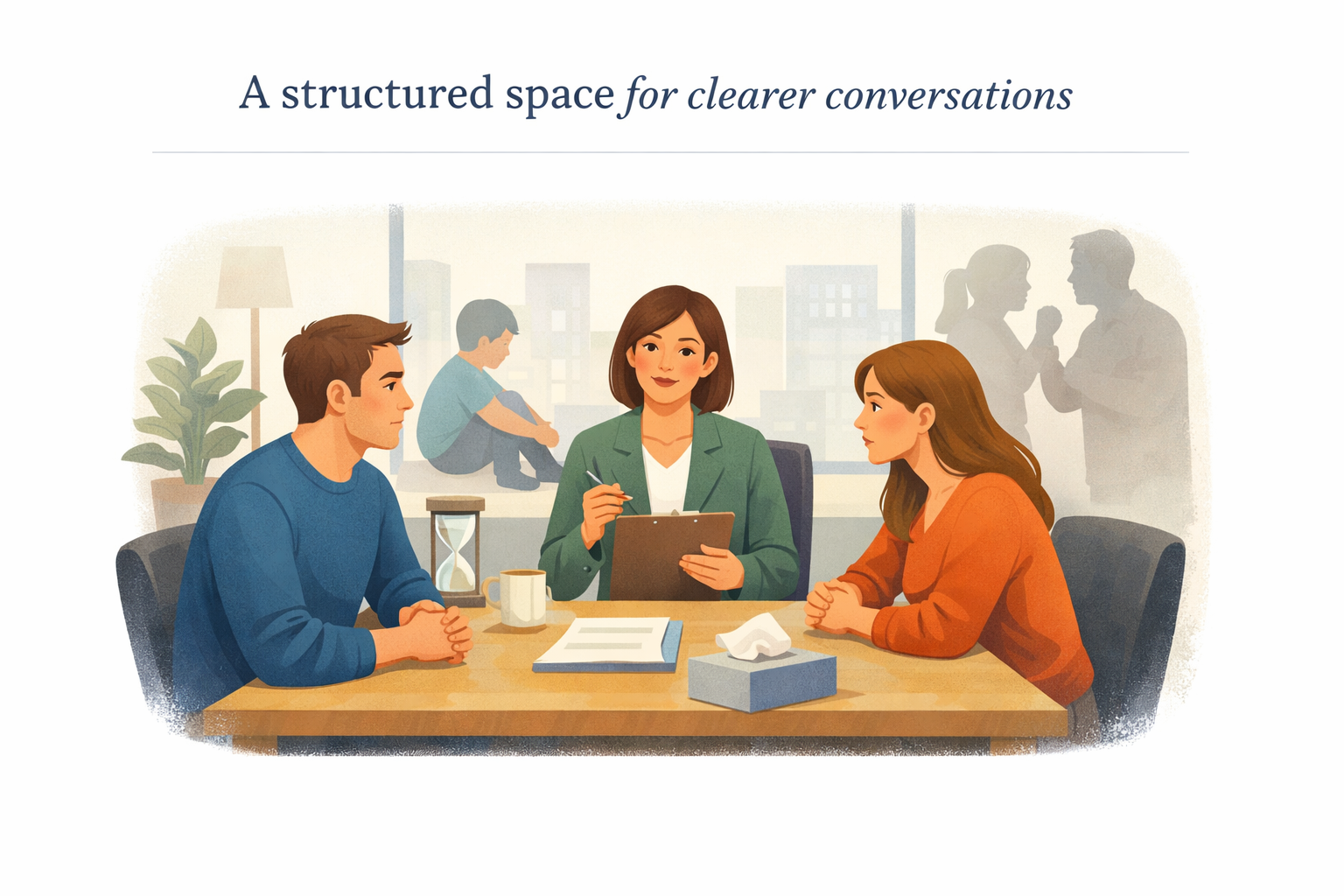
If you are unsure whether mediation is the right option for your situation, a neutral initial conversation can quickly clarify the process and what to expect.
The first step is always an initial confidential conversation a brief, informal opportunity to explain the process, answer any questions and assess whether proceeding to a MIAM is appropriate. There is no obligation to proceed further at any stage.
Mediation is voluntary and proceeds only with informed consent. It can be paused at any point if safety concerns arise or if circumstances change. The aim is always to give families more control over their own outcomes and to reach practical agreements they can genuinely live with.
Family separation is rarely straightforward but the decisions that follow do not have to be made in an atmosphere of conflict and uncertainty. Mediation offers a structured, respectful alternative that keeps children's needs at the centre, reduces the emotional strain on every family member, and produces practical agreements that families can actually live with.
The process is confidential, voluntary and guided at every stage by experienced, impartial practitioners whose only priority is the wellbeing and safety of the families they support. Whether the matter is straightforward or complex, mediation offers a calmer, more human way to move forward with greater clarity, less conflict, and more confidence in the road ahead.